Monday, January 25, 2010

Slavery in America


Click on the link to see four readings on slavery in the United States. Work with your partners to answer the following questions:

1. For the first reading, paraphrase Thomas Jefferson's comments about slavery.
2. Read the second and third readings. Which do you think is a more accurate description of slave life? Explain your answer with specific examples from the texts.
3. In the forth reading, the author says slavery is actually good for the slave. What are two reasons the author gives?

Extra Credit: In the forth reading, the author says that slaves are better off than people working for wages. In your own words, what are the author's reasons?

Tuesday, January 19, 2010

Trail of Tears

Read the account of the Trail of Tears from the National Park Service website. Answer these questions:
1. What happened to the Cherokees in the period of May to October 1838? What was life like for the Cherokees during that time?
2. What do you think was the worst part of the relocation? Why?
3. Andrew Jackson believed that "the majority rules." It is true that Indian removal was a very popular policy with voters over many years in the 1830s. Should the majority of voters be able to do anything they want? Why or why not? Should a minority of voters be able to stop the will of the majority? Why or why not?
4. Reread Professor Thomas' story? Do you think it is really happened that way?  Was the woman really Professor Thomas' grandmother? Is it important if she is not really his grandmother? Do you think the story was intended as factual history, or had another purpose? Explain (tell why or why not) your answers.

Monday, December 7, 2009

War of 1812 -- Fort McHenry


The Battle for Fort McHenry is the basis for the "Star Spangled Banner," the national anthem of the United States. Use the links to answer these questions:

1. Baltimore was an important site for shipping. Look at the map and give at least two reasons why Baltimore was a good location for merchants and shipping. 

2. Why do you think Fort McHenry was located where it was?

3. Find "Lazaretto Battery." A battery is a term used for a group of big, long range cannons. Why do you think Lazaretto Battery was located where it was?

4. Fort McHenry was known as a "star fort." Closely look at the diagram of the fort. What advantages would a fort shaped like Fort McHenry have? 

(Lesson adapted from the Teaching with Historic Places Website)

Sunday, November 29, 2009

Barbary Pirates


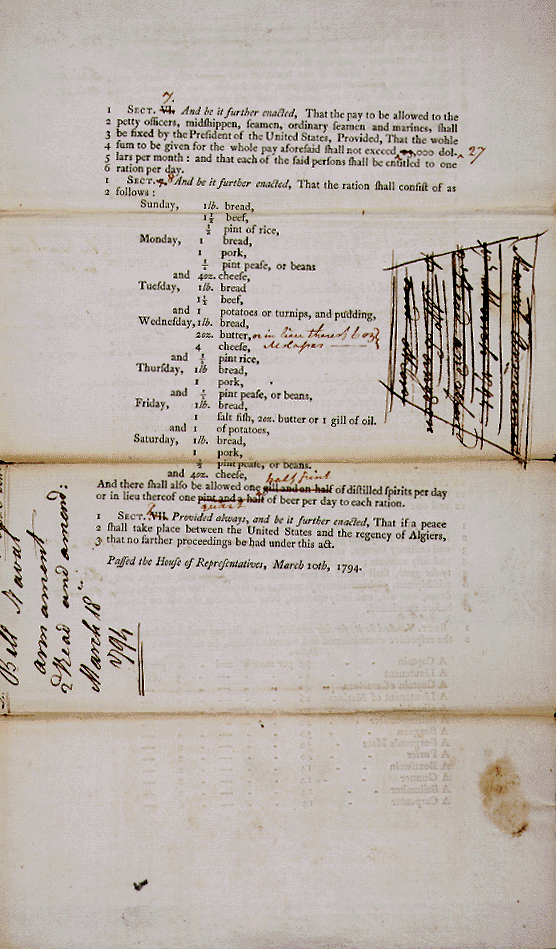
As you have learned, one of the most important issues facing President Jefferson was how to handle the issue of the Barbary pirates. To help you see one of the U.S. government's responses, let's examine a primary source document. You'll need to click on page 1 and page 2 of the document, and work with your partner to complete the "Written Document Analysis Worksheet." 

For extra credit, click on the "comment" link and explain how the issue that President Jefferson faced with the Barbary pirates in the early 19th century is still a current issue in 2009. 

Sunday, November 22, 2009

The Sedition Acts


Thomas Cooper was a lawyer and newspaper editor in Sunbury, Pennsylvania, was charged with violating the Sedition Act. He went on trial in 1800, convicted, and fined. To learn more about the case, view the arrest warrant that was issued in the case. To see a transcript of the warrant, click here, and select "sedition_acts_cooper" from Mr. Albert's web page. Use these documents and what you know about the Sedition Act to answer the questions below:

1. In your own words, describe what Mr. Cooper was charged with based on the arrest warrant. Use your online dictionary for unfamiliar words.

2. As you know, James Madison wrote the Virginia resolutions, and Thomas Jefferson wrote the Kentucky resolutions. These resolutions said the states could declare a federal law "unconstitutional," and not follow that law. What would happen if states actually refused to follow laws that the states feel do not follow the Constitution? 

Monday, November 16, 2009

Washington's Farewell Address


As George Washington retired from the Presidency in 1796 after serving two terms in office, he wrote a "farewell address" to the American people. Although many people today think that the Farewell Address was a speech, it was actually published in newspapers. Alexander Hamilton, who had been the Secretary of the Treasury, wrote the first draft, and Washington made changes.

Washington made three main points. First, he said that while the newly independent United States should trade with other countries, the US should not make military alliances (agreements) with any foreign country since that could pull us into a war that did not affect us directly. He also warned against having political parties. Washington felt that if there were political parties, voters would follow who the party said to vote for, rather than being informed and voting for the best candidate. Finally, he felt that religion was an important "pillar" for American morals. In others words, if people went to church regularly, they would know the difference between right and wrong, and make better decisions for themselves, their families, and their communities.

Now it's your turn. Do you believe that Washington's advice in the farewell address is still good advice for the United States in 2009? Write a well written paragraph, and address Washington's three major points:
  • The US should avoid foreign military treaties
  • Political parties are bad for the country
  • Belonging to a church helps make people better citizens since they know right from wrong
Be sure to explain your answers and give reasons to back up your ideas

Tuesday, November 3, 2009

Washington's Rules of Civility


George Washington wrote his "Rules of Civility and Decent Behavior" when he was a teenager as an assignment in school, probably to practice his handwriting. Although he didn't invent these rules, respect and proper behavior were important to him, and he tried to live by these rules throughout his life and career as a general of the army and President of the United States.

Your assignment is to put 3 of the rules into your own words, and explain why following them might have helped Washington as a military and political leader. Be sure to "copy-paste" the text of the rule to your response.