Friday, February 26, 2010

Soldier Letter from the Mexico-USA War

Click on the link to a letter  from a soldier in the Mexico-USA War published in the periodical "Yankee Doodle."  As you read the letter, respond to these 4 questions:

1. In the first paragraph, what did the writer expect from going to war?
2. In the second paragraph, what did the writer find instead?
3. In the third paragraph, what advice would the writer expect from his mother, and what did he think of that advice?
4. In the forth paragraph, what was going to happen next?
5. What was in the letter that surprised you? Was anything missing from the letter that you expected to be there?


Sunday, February 7, 2010

Health and Illness in Early Factories


According to the text, many workers in the mills got sick and were injured on the job or in inadequate housing provided by the mill owners. Was that true? We can use a primary source document, a page from the hospital log at Lowell, Massachusetts, to find out. Click on a transcript of the hospital log to answer the question:

1. What were the diseases and illnesses that afflicted the workers on the hospital log? In simple terms, what kind of disease or illness was it? How many people were suffering from each disease or illness? Were the diseases or illnesses related to work or life at the mill? Why or why not?

Monday, January 25, 2010

Slavery in America


Click on the link to see four readings on slavery in the United States. Work with your partners to answer the following questions:

1. For the first reading, paraphrase Thomas Jefferson's comments about slavery.
2. Read the second and third readings. Which do you think is a more accurate description of slave life? Explain your answer with specific examples from the texts.
3. In the forth reading, the author says slavery is actually good for the slave. What are two reasons the author gives?

Extra Credit: In the forth reading, the author says that slaves are better off than people working for wages. In your own words, what are the author's reasons?

Tuesday, January 19, 2010

Trail of Tears

Read the account of the Trail of Tears from the National Park Service website. Answer these questions:
1. What happened to the Cherokees in the period of May to October 1838? What was life like for the Cherokees during that time?
2. What do you think was the worst part of the relocation? Why?
3. Andrew Jackson believed that "the majority rules." It is true that Indian removal was a very popular policy with voters over many years in the 1830s. Should the majority of voters be able to do anything they want? Why or why not? Should a minority of voters be able to stop the will of the majority? Why or why not?
4. Reread Professor Thomas' story? Do you think it is really happened that way?  Was the woman really Professor Thomas' grandmother? Is it important if she is not really his grandmother? Do you think the story was intended as factual history, or had another purpose? Explain (tell why or why not) your answers.

Monday, December 7, 2009

War of 1812 -- Fort McHenry


The Battle for Fort McHenry is the basis for the "Star Spangled Banner," the national anthem of the United States. Use the links to answer these questions:

1. Baltimore was an important site for shipping. Look at the map and give at least two reasons why Baltimore was a good location for merchants and shipping. 

2. Why do you think Fort McHenry was located where it was?

3. Find "Lazaretto Battery." A battery is a term used for a group of big, long range cannons. Why do you think Lazaretto Battery was located where it was?

4. Fort McHenry was known as a "star fort." Closely look at the diagram of the fort. What advantages would a fort shaped like Fort McHenry have? 

(Lesson adapted from the Teaching with Historic Places Website)

Sunday, November 29, 2009

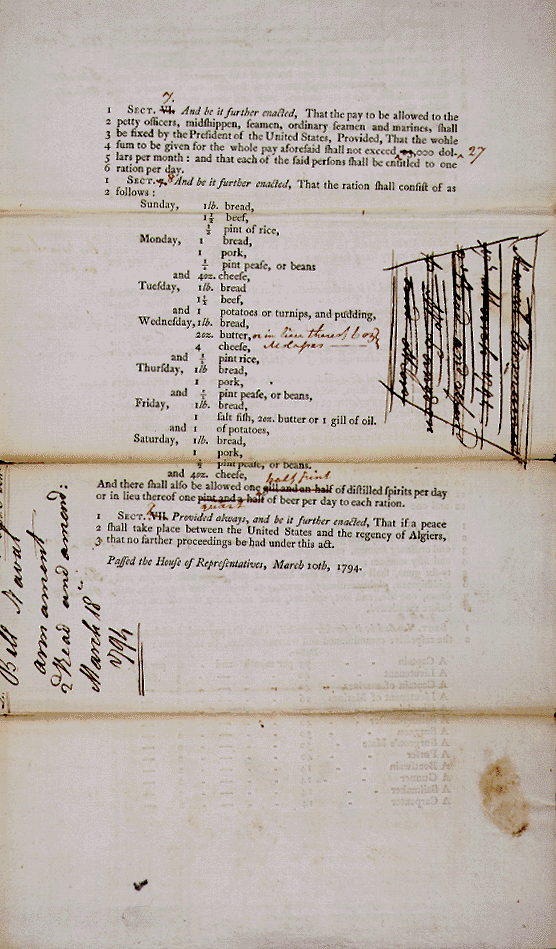
Barbary Pirates


As you have learned, one of the most important issues facing President Jefferson was how to handle the issue of the Barbary pirates. To help you see one of the U.S. government's responses, let's examine a primary source document. You'll need to click on page 1 and page 2 of the document, and work with your partner to complete the "Written Document Analysis Worksheet." 

For extra credit, click on the "comment" link and explain how the issue that President Jefferson faced with the Barbary pirates in the early 19th century is still a current issue in 2009. 

Sunday, November 22, 2009

The Sedition Acts


Thomas Cooper was a lawyer and newspaper editor in Sunbury, Pennsylvania, was charged with violating the Sedition Act. He went on trial in 1800, convicted, and fined. To learn more about the case, view the arrest warrant that was issued in the case. To see a transcript of the warrant, click here, and select "sedition_acts_cooper" from Mr. Albert's web page. Use these documents and what you know about the Sedition Act to answer the questions below:

1. In your own words, describe what Mr. Cooper was charged with based on the arrest warrant. Use your online dictionary for unfamiliar words.

2. As you know, James Madison wrote the Virginia resolutions, and Thomas Jefferson wrote the Kentucky resolutions. These resolutions said the states could declare a federal law "unconstitutional," and not follow that law. What would happen if states actually refused to follow laws that the states feel do not follow the Constitution?