Sunday, March 15, 2009

Seneca Falls Declaration

By basing the Seneca Falls Declaration (also known as the Declaration of Sentiments) on Thomas' Jefferson's Declaration of Independence, Elizabeth Cady Stanton and her fellow reformers challenged the Nation to live up to its original creed.
1. Only 1/3 of the three hundred people at the convention signed the Declaration. Why do you think that the other 200 didn't sign? If you had been there, would you have signed? Why or Why not?
2. Re-read the next to last paragraph. What is the plan to gain equal rights? Is it a good plan? Why or why not?

Click on the link to the political cartoon drawn by Elizabeth M'Clintock, a supporter of women's suffrage.  
1. What do you notice about the figures in the cartoon?
2. What do you think is the cartoonist's message? Explain your answer.

Tuesday, March 3, 2009

Women's Rights Movement


Read about the early women's rights movement by going to the National Park Service website for the M'Clintock House, where many of the women and men who fought for equal rights met.  In which aspects of life in the early 19th century were women's rights restricted? How did people justify those restrictions?

Thursday, February 26, 2009

Oregon Trail

What are the three most important things that students should know about the Oregon Trail?Why are those things important?   

Saturday, February 14, 2009

Two Views of the Alamo

The Battle of the Alamo was took place between February 23 and March 6, 1836. It became the most famous battle of the Texas Revolution. Eyewitnesses report that between 182 - 252 Texans were killed, there were no survivors among the defenders, except for Joe, who had been a slave of one of the Texans. The women and children of the Texans were released. Estimates of the killed and wounded in the Mexican army are estimated at 400-600. 

Who was to blame for all of this bloodshed? You have read primary source documents written by Colonel Travis, the commander of the Texans, and General Santa Anna, commander of the Mexican army. Answer the questions below:

1. Summarize the main ideas of Colonel Travis' letter.
2. Summarize the main idea of General Santa Anna's letter.
3. Was Travis or Santa Anna more to blame for the deaths that occurred? Why?
4. Look at the dates on the two letters. Colonel Travis' letter was written during the battle, while General Santa Anna's letter was written many years later. Do you think that makes one source more believable or reliable than the other? Why or why not?

(General Santa Anna's letter, above, right)


Wednesday, February 11, 2009

John Locke & E-mail

1. What did you learn about John Locke's ideas?
2. What did you learn to do today with email?

Wednesday, February 4, 2009

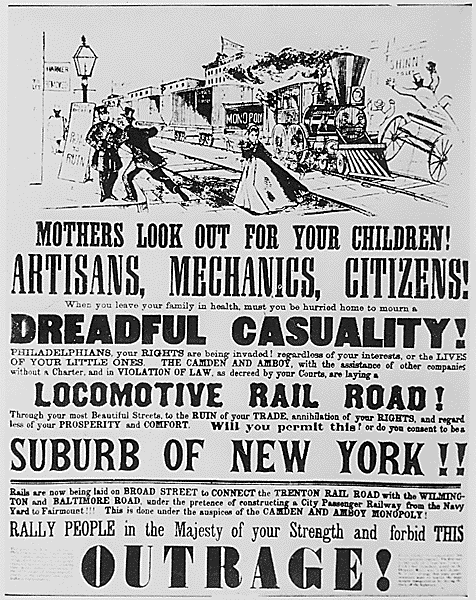
Railroads: Good or Evil?


While railroads helped the United States become more prosperous in the first half of the 19th century, there are two sides to every story. Study the poster from the National Archives, and answer the following questions:
1. What is happening in the picture? Describe all the people, things and actions taking place
2. Who is the intended audience for the poster? What makes you think that?
3. What is the message that the poster is trying to tell to the viewer? 

Tuesday, February 3, 2009

Netiquette

Go to the link about netiquette, and post your responses to these three questions:
1. Where there any rules of netiquette that you did not know about? If so, which one(s)?
2. Which rule of netiquette do you think is the most important? Why?
3. If you had to add one rule to this list, what rule would it be and why?
4. Based on what you know, write a dictionary definition of netiquette.